When two Christians defend abortion, Jon Noyes argues that Christian ethics must follow Christ rather than culture by extending dignity and protection to the unborn.
Transcript
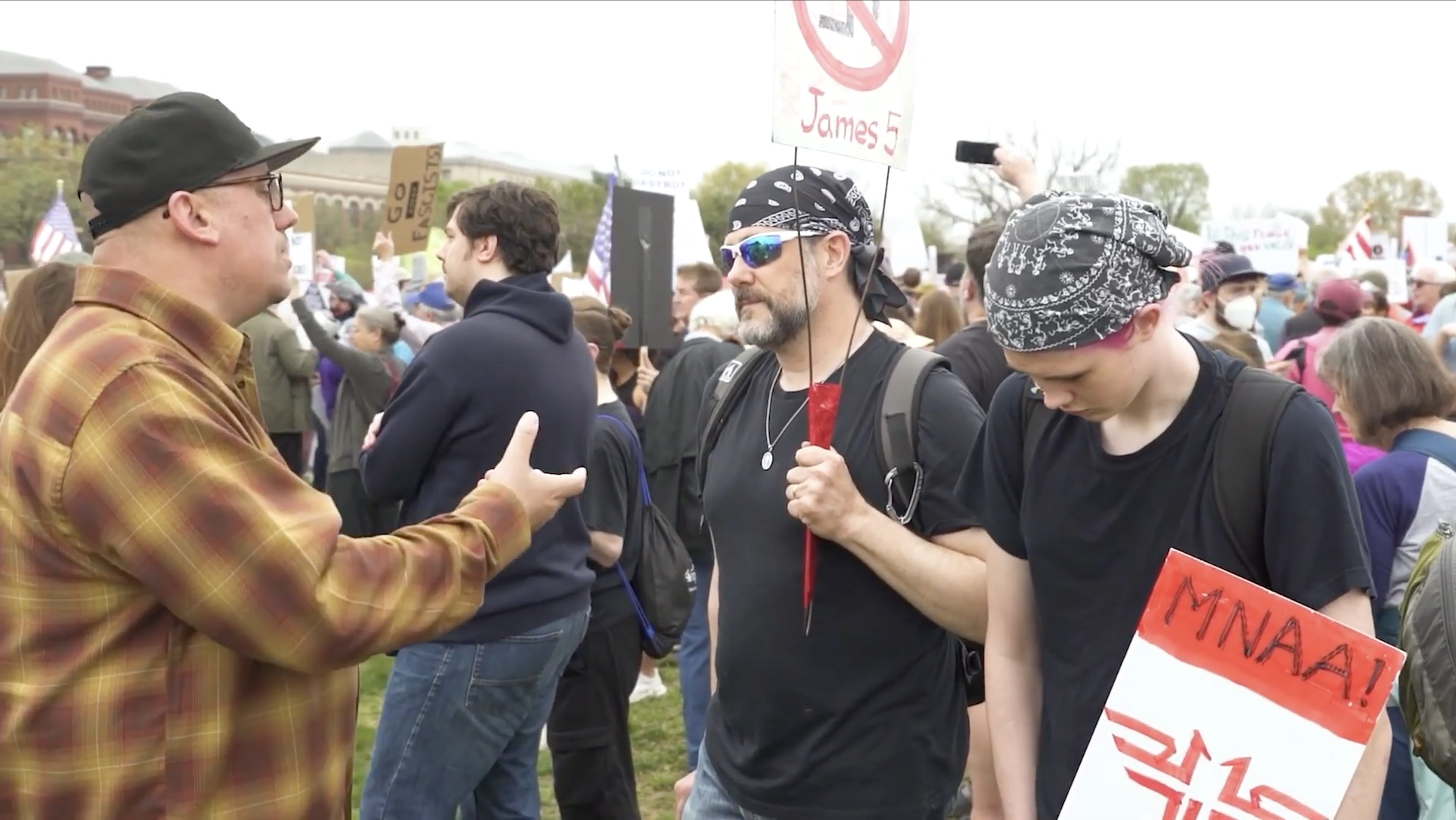
Jon: How do you stand in your position with the pro-life issue, then, as a Christian?
Protestor 1: There is nothing in the Bible that is anti-abortion.
Jon (commentary): In this next video, this is where I’m going to ask a father and a son, both professing Christians, to reconsider their pro-choice stance in light of what they say they believe. And if you’re paying attention, you want to see the tactic that’s coming. I’m asking a question, of course, and I’m saying, “As a Christian man, would you reconsider your position?” And in this question, I’m trying to expose an internal worldview tension he’s having, because these people, they’re affirming the image of God in some people but not in the unborn. So, there’s a moral inconsistency. And then I’m going to try to encourage a coherence between faith and ethics. So, let’s watch the video and see what happens.
Jon: So, that’s actually—I’m trying to pull that out of people here. I’m a pastor, and I see a moral sign. There’s a lot of moral statements going on here, and I’m just wondering, where are we getting that understanding of good and bad from? But you’re a Christian. So, that’s where we find our grounding.
Protestor 1: If I weren’t a Christian, there’s also natural law, and we can agree on what’s right and wrong without—
Jon: Without belief in God.
Protestor 1: Without having somebody to tell us what’s right and wrong.
Jon: Well, that’s because we’re made in the image of God. Whether we believe in him or not, we’re made in the image of God.
Protestor 1: That’s what natural law points to.
Jon: And that’s a law above the law, is the way the founders would say it. So, natural law comes from a natural Lawgiver outside of ourselves. So, it’s not up to us to define what good and bad is. It’s up to God.
How do you stand in your position with the pro-life issue, then, as a Christian?
Protestor 1: There is nothing in the Bible that is anti-abortion. The Israelites understood that it was sometimes a necessity.
Jon: Where was it a necessity with the Israelites?
Protestor 1: Well, there’s actually Scripture—I can’t cite it—that talks about what you need to do, and it’s actually a punishment, in some cases, for adultery.
Jon: It was a test. So, it was a test for adultery.
Protestor 1: But if you died, you were being punished for your adultery.
Jon: So, it wasn’t an abortion, so to speak. It was a test for adultery.
But, I mean, clearly, Exodus tells us that we shouldn’t murder, right? And what’s murder? The unjust taking of an innocent human life, right?
Protestor 1: Well, that was only really defined in Western thought in the Greco-Roman period. Like, “life begins at conception” is a Greco-Roman idea, not an Israelite or Christian idea.
Jon: Life beginning at conception is a scientific idea.
Protestor 1: Well, the Hebrews define life as beginning at birth.
Jon: Well, no, I don’t think so. No, scripturally not. We know this because when Jesus interacted with John the Baptist the first time, they were in their mothers’ wombs, and Jesus leapt. So, you have first-trimester Jesus interacting with second-trimester John the Baptist. So, clearly, there was life there, and clearly, God says that all people are fashioned in the image of God, and that would include, I think, the unborn as well. I mean, I think the Scriptures are clear here.
Protestor 1: Let me go back to history a little bit. The anti-abortion movement really took off as the civil rights movement was winning because the Southern leadership that was anti-civil rights needed a safer way to come out in public and protest against the people they didn’t like.
Jon: No, I think, actually, that’s backwards. I think if you look at the pro-abortion—as the pro-abortion issue got going with Margaret Sanger’s founding of Planned Parenthood, Margaret Sanger was an avid racist, believed in eugenics. I mean, this is written in her writings. One of the reasons why she founded Planned Parenthood was because she wanted to extinguish the African-American race. If you look at most of our Planned Parenthood facilities, they are in inner cities, poorer neighborhoods, largely and predominantly the people that we both support. So, it’s having a larger impact within those communities, and it stems from the foundations of Planned Parenthood. And I would say that the pro-life movement has been there constantly throughout the civil rights movement, and the modern-day civil rights movement is now the pro-life movement.
Jon (commentary): So, in this part of our conversation, I’m shifting from questioning to challenging, but I do it respectfully. These two men have expressed a deep compassion, love for justice, and even acknowledgement of Christian truth, which I admire. There’s common ground. And that’s what made the conversation, I think, so fruitful. But when it came to the question of abortion, the reasoning, it didn’t line up with their worldview.
Protestor 1: But the reason I call it a distraction is that it keeps our country, as a whole, from doing the things. I think it’s most often, probably, desperation. I can’t support this now in my life. I can’t support this now in my life.
Jon: This what?
Protestor 1: This child.
Jon: This baby. So, they want to kill it.
Protestor 1: Instead of doing the things that make our country livable for people, that make our economy work for individuals instead of corporations, we’re spending a lot of our political exercise making the people who can’t make it in this economy criminals.
Protestor 2: I think that the proper response here, also as a Christian, is not to criminalize abortion, because, again, the 1–2% of cases where it is—
Jon: Life of the mother, rape, incest. Two percent.
Protestor 2: Yeah. But I think that we should focus on making our economy and making America a safe place for mothers. Every family should be able to have a child. Every working-class family should be able to have the means to support a child. And we are not in that place right now. And I think that’s something that most Americans could agree on. Every working-class family should have the means to support a child.
Jon: So, I just want to be clear. So, the response—with two Christian men standing in front of me—the response is to kill the babies.
Protestor 2: No, the response is to make it so that the mothers—look, I don’t agree.
Protestor 1: Let’s fix the country.
Jon: And then save the babies.
Protestor 1: That will save the babies because if people don’t reach that point of desperation, they’re not going to take that.
Protestor 2: I feel like it’s a “do both” kind of thing.
Jon: I think it’s a “do both” kind of thing, too. But I think that there’s certain laws that supersede other laws. And I think the right to life is the right that should supersede.
Jon (commentary): So, I asked the father directly, “As a Christian man, would you reconsider your position?” This is what it looks like to call someone to repentance, I think, out in the culture today—not with a sermon and not with shame, but with a challenge rooted in shared truth.
Jon: But I think, as Christian men, we need to be standing for life above all else, because without that basic fundamental—like, I can’t go around—like, if I fall on desperate times, I can’t kill my eight-year-old. But if I fall on desperate times and my wife becomes pregnant, it’s okay for me to kill the baby in her. Why is that?
What I would like you to do, and I’m just going to say, as a Christian man, is reconsider your position on abortion. I think you’re right on this stuff, right? Equality for all, regardless of race, religion, creed, whatever it might be, because we’re made in the image of God. But there’s a whole group of people—millions of people—who we, as a society, have come around and said, “It’s okay to kill you.” And as Christian men, we should be standing up to that because then that’s a consistent view. I think your view is inconsistent, because you’re saying that these people are valuable but not these people.
Jon (commentary): I didn’t question the men’s sincerity. I didn’t doubt their compassion. I simply asked them to consider whether their beliefs about justice and dignity extended consistently to the unborn. This kind of challenge is rare in our culture today, unfortunately. But we need to be more willing to do it. If someone claims Christ, we should expect their ethic to follow Christ, not culture. I don’t think that’s arrogance. It’s accountability within the family of faith. You see, when he says he’s a Christian, that means he’s my brother, and that means I have the opportunity—I have the responsibility—to call him to repentance.
The people I’m speaking to, they share real concerns about poverty and miscarriages and health care access. So, what I try to do—notice this—is I move towards them. This is a tactic. I move towards them in agreement, and I affirm these concerns. Where I can affirm them, I affirm them. I, too, care about poverty and health care and these things. But then I ask a hard question. I don’t just stay there in agreement. I ask the hard questions. “So, the response is to kill the babies?” is what I said. If you notice, that’s a hard question.
And I want to make sure that I’m clear here. This is not a rhetorical jab. This isn’t a gotcha moment. It’s a real question. Is the proper response to alleviate the suffering to kill babies?
It’s a moment of moral clarity. That’s what I’m seeking. We’re talking about ending a human life. And often, people justify that with what’s called an appeal to the hard cases, using the 1 or 2% of tragic scenarios—and they’re tragic scenarios, guys—but we’re using those 1 and 2% of tragic scenarios to justify the other 99, 98% of abortions. It’s actually a logical fallacy, and it’s a devastating one.
I’m not dismissing the pain, but we can’t let compassion override consistency. The answer to a broken system isn’t killing the most vulnerable. It’s building a better system and protecting all life while we do it. See, compassion and justice—they have to walk hand in hand. Justice never demands the death of an innocent human being.