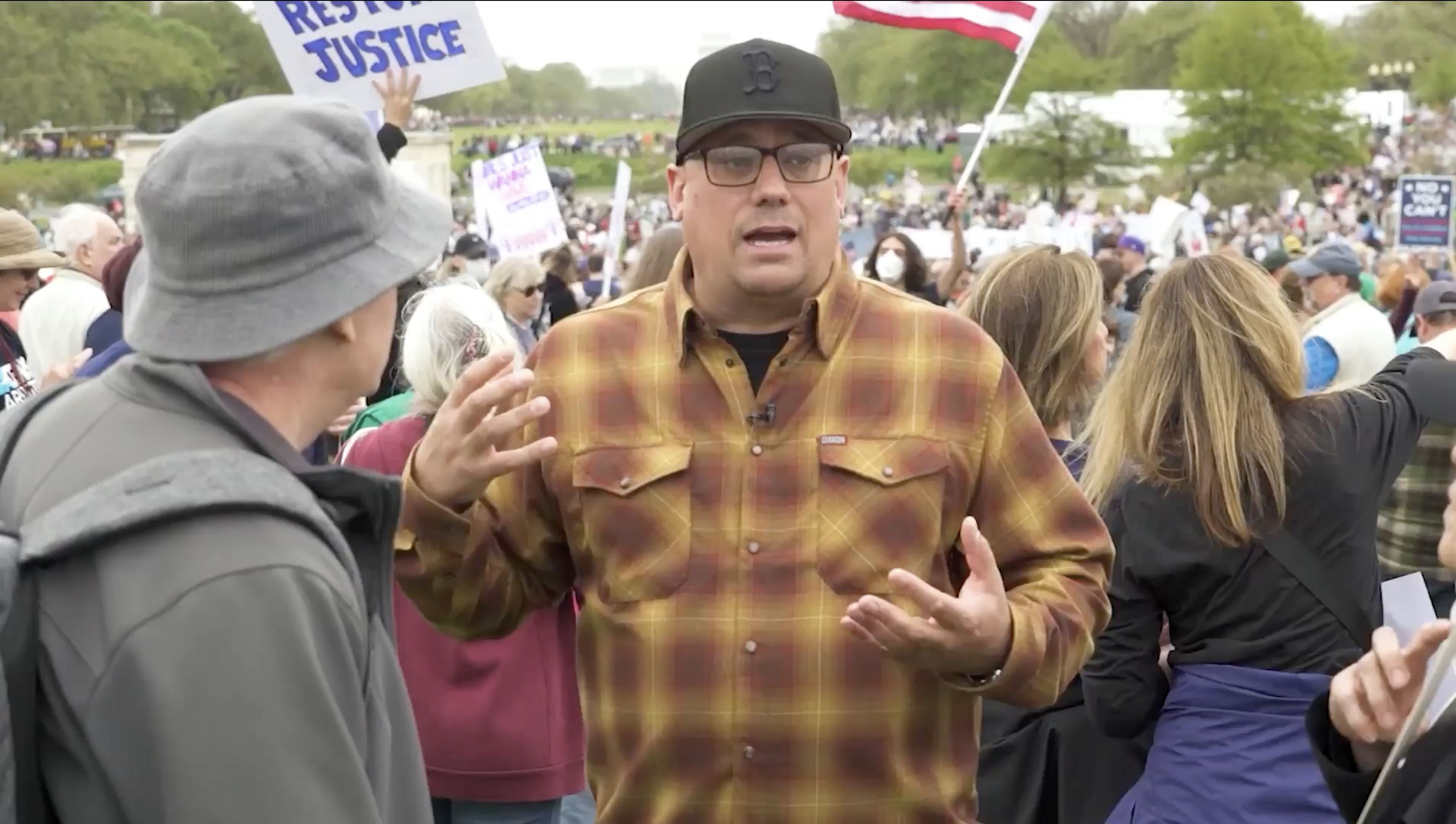
Jon Noyes talks to protestors at a women’s rights march about whether Jesus was an exclusivist, if all religions pray to the same God, and what grounds our values.
Transcript
Jon: I don’t know. It’s actually an interesting—
Protestor 1: I’m done.
Jon: Thank you. What? Are you done, too? It seems to me like you don’t want diversity.
Protestor 1: You don’t want to listen.
Jon: I feel like I’ve done a good job of listening, sir.
Jon (commentary): As you watch this video, notice I open up with—you guessed it—a question.
Jon: Why do you guys think democracy and, like, the stuff we’re talking about—why do you think it’s important? Where does it come from?”
Jon (commentary): This time, I’m focusing on rights, morality, and democracy. And the people I’m talking with, I have common ground with because they offer some answers grounded in American values. But notice that they don’t ultimately offer transcendent grounding for their values.
Protestor 1: How can you agree with what they’re doing right now?
Jon: Like, what—what part of it?
Protestor 1: All of it. Think about—okay, just let’s do one thing. What about firing scientists? What about getting rid of our protections? What about people who are working to try to keep your water safe and your air clean?
Jon: Yeah, all of that’s really, really important. I agree with you.
Protestor 1: No, not just important. Why would you fire them? What’s the point?
Jon: Yeah. Well, I don’t necessarily agree with that. I actually don’t know a lot of what you’re talking about. I am happy to say I’m ignorant in the areas where I’m ignorant, but I also think that the government oversteps in certain areas. But I think, also, this government is doing a lot of good things as well.
Protestor 2: Like what?
Jon: Well, I think measures for the unborn have been really great. I’m a pro-life advocate. So, I think human life is really important. I think it starts at conception.
Protestor 2: So, what else? Because I know a lot of people voted for him just for that, because suddenly he became pro-life.
Jon: I think also, like, I think what happens is we’ve been stuck in an ecosystem, and all of us live in these little bubbles, and we don’t get outside of it. And I think that we’re seeing that a little bit here where I’m just trying to have conversations with people. But why do you guys think democracy and the stuff we’re talking about—why do you think it’s important from a larger perspective? Like, where does it come from—our understanding of rights, our understanding of what’s right and wrong?
Jon (commentary): Notice that I asked the question “Where do rights come from?” This is getting to the deeper issue, which is really what I want to do. I’m trying to get underneath the surface issue in my conversations to the deeper worldview problems that are happening.
Jon: You mentioned that we’re all created equal, and the only way that we’re created equal is if there’s a source above us, and that source would be God. Right? So, God is what gives us our identity.
Protestor 1: Your story or your definition of how that works and somebody else’s story of how it works—it’s not that they’re talking about two different things. It’s just the way they’re talking about it, the way they’re telling it, the way they’re telling that story. I’m not gonna go into the whole story of how the Bible was written, but that was all from a lot of sources pulled together. And fine, if that’s the basis of religions, that’s great. But there are other also similar things that are the basis of religions. They’re all doing the same thing. This is what’s so frustrating. Just, like, all of the diversity in the country—everybody wants to have their own freedoms and things like that. Similarly, all the people that pray to whatever god they have, they’re doing the same thing and, I hope you would agree, they’re all doing it to the same God.
Jon: Well, no, I wouldn’t agree.
Protestor 1: They’re doing it different ways. Humans do things in their own ways.
Jon: But Jesus says, “I am the way, the truth, and the life.” Right? Whether it’s true or not is not what I’m arguing right now. Jesus says, “I’m the only way.” Right? “The only way to the Father is but by me.” Muslims don’t teach that. Muslims teach that Jesus is a prophet who never died and therefore wasn’t raised. Jews teach that Jesus was a false prophet who died and was buried and stayed dead. So, all three of those things can’t be true at the same time.
Jon (commentary): The people I’m speaking with, they argue that all religions are just different paths up the same mountain, but that’s simply just not true, because it’s not possible. You see, Islam says that Jesus didn’t die. Christianity says Jesus did die and was raised. Judaism says that Jesus died and stayed dead. Do you see the problem? In just the person of Jesus, taking the three major monotheistic religions, we see that they have different claims about who Jesus is, and they all can’t be true at the same time. They could all be false, but they can’t be true. And if one is true, the others are false.
Keep in mind, in the clip, it was alluded to that this type of claim to know the truth is arrogant, but this isn’t arrogance. It’s called logic. As I gently point this out, contradictory truth claims can’t be both true and false at the same time. This is why worldview conversations aren’t about personal preference. They’re about objective truth. All religions can be false, but they can’t all be true, because truth, by definition, is exclusive.
Jon: I think there’s good evidence.
Protestor 2: Yeah. So, I’m, I’m a Catholic. He’s an atheist. But I don’t see…. To me, it’s just faith. I have absolutely no evidence. It is faith—what I choose to believe.
Jon: What do you mean by “faith?” When you say “faith,” I just want to know what you mean.
Protestor 2: Faith is just believing something when you don’t have any evidence.
Jon: So, is that what you think faith is as well?
Jon (commentary): When people say faith is believing without evidence, that’s not Christianity. That’s a caricature of what Christianity is. Biblical faith—true faith—is trust based on evidence. You see, Jesus didn’t ask people to believe blindly. He offered reasons—his miracles, his fulfillment of prophecy, and most importantly, his resurrection.
This misunderstanding here shows why defining terms is so important at the onset of a conversation. If we’re going to talk about faith, we need to be clear on what we mean. And this is where I think asking questions really shines. “What do you mean by that?” It opens the door to correct misunderstandings and allows us to plant seeds of truth.
Faith isn’t a blind leap. It’s reasonable trust based on what God has already done.
Protestor 2: But you are convinced that Jesus is the right way.
Jon: Well, as are you, because you’re Catholic. Right?
Protestor 2: Yes. Exactly.
Jon: So, why are you convinced that Jesus is the right way?
Protestor 2: It’s the way I was brought up.
Protestor 1: But is it the only way?
Protestor 2: No, it is not.
Jon: But that’s not Jesus’ way. Jesus says that “I am the only way.”
Protestor 1: Well, then he got that wrong.
Jon: Jesus got that wrong? In this conversation right now, you think you’re right. Right?
Protestor 2: I do think I’m right. I’m not a hundred percent right.
Jon: But the reason why is because I have a grounding issue, because I find value in human beings because they’re dignified just by the very fact that they’re human beings, because they’re made in the image of God.
Protestor 1: Then how do you know anything? This conversation’s going to end. If you’re only basing what you know on one book, then you’ve really got to give that a second thought.
Jon: Well, I’ve read a lot more than one book. You’re, you’re a self-proclaimed atheist. Yes? That means something. What does the word “atheist” mean to you?
Protestor 1: I believe the greatest thing about this country is that the planet, the people in this world can come here and be a part of this because it was never meant for one type of person.
Jon: I agree. But why is that so? That’s what I’m saying. Like, these are moral statements that we’re making, and I don’t think you have a grounding to make these moral statements as to why these things are important. Why is it a good thing? Why is diversity good?
Protestor 1: Well, look at the Statue of Liberty. What’s that about?
Jon: It’s diversity, but why is that good? You’re pointing to an example of something.
Protestor 1: Because the bigger you can look, the bigger perspective you have, the more you understand what humans are. And if Jesus was able to get on a plane and travel around the world, he would also be a worldview kind of person.
Jon: Well, he is a worldview person, but he’s also an exclusivist.
Protestor 1: Yeah. In your world.
Jon: I don’t know. It’s actually an interesting—
Protestor 1: I’m done.
Jon: Thank you. Are you done, too? But it seems to me like you don’t want diversity.
Protestor 1: You don’t want to listen.
Jon: I feel like I’ve done a good job of listening, sir.
Jon (commentary): So, this is at the heart of the worldview clash: value, dignity, and worth.
My conversation partner here celebrates human diversity, which I fully agree with. But then I ask a question. Why? Why are those things important? Because on atheism, guys, let’s just be truthful—and I know this from experience because I was an atheist for so long—we’re just cosmic accidents. We’re moist robots. That’s what we are. We’re molecules bumping into each other. So, why does one clump of atoms, one moist robot, deserve dignity more than any other?
You can’t have objective human rights without an objective basis for human worth. That’s why Christianity grounds human dignity in the image of God. Atheists live like people have value, but their worldview can’t explain why. It’s a huge problem. It’s called the grounding problem. They’re borrowing from a truth that they deny. Atheists live like people matter because, deep down, they know they do. That’s God’s image breaking through.