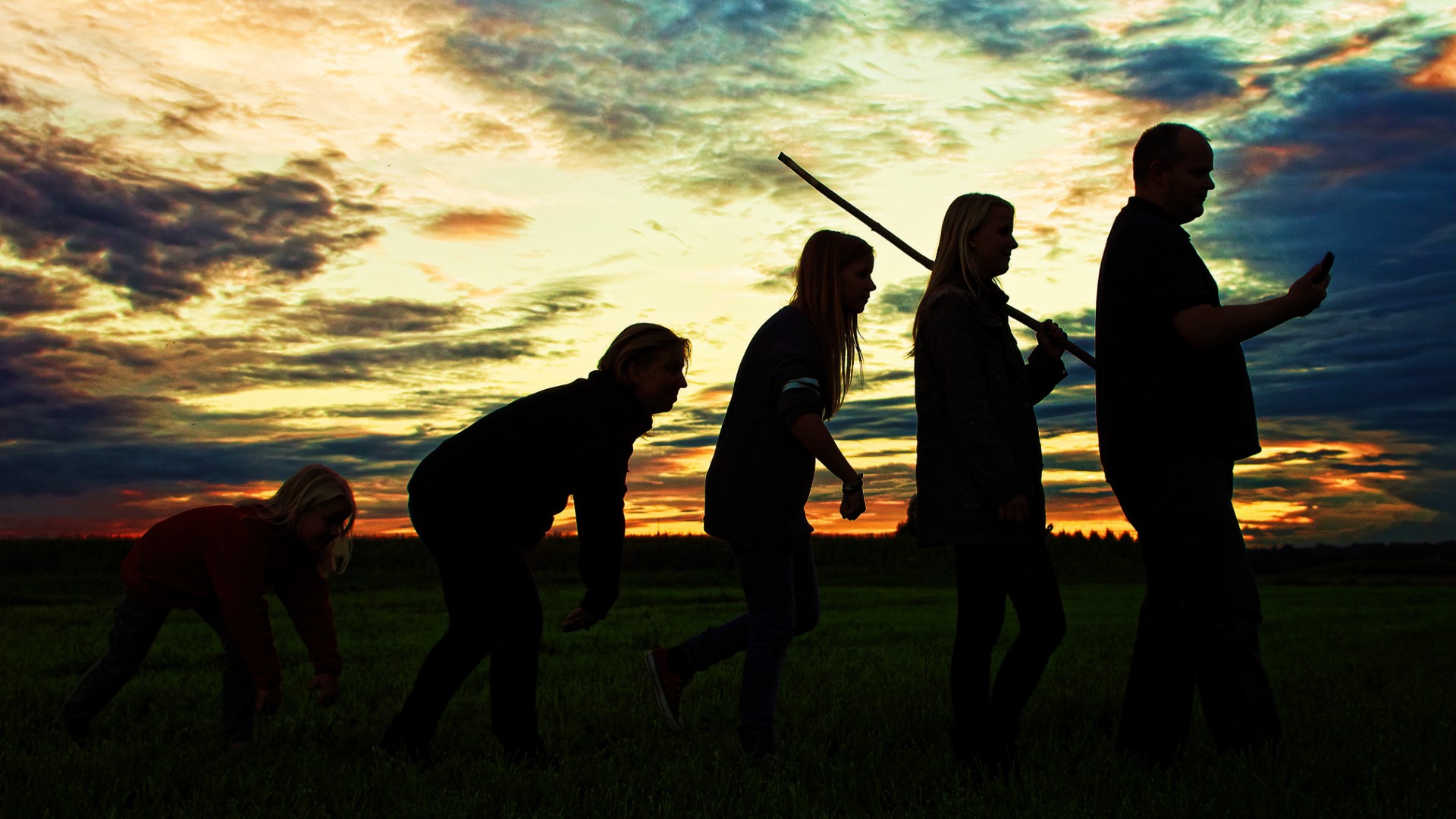

[The following material is adapted from Greg Koukl’s article in the CSB Apologetics Study Bible for Students.]
Can a Christian believe in evolution? The troublesome thing about this question is the word “evolution.” It means different things to different people.
For example, evolution can simply mean change over time. When the word is used this way, no one raises an eyebrow. A more controversial definition includes the idea that all living things have descended with modifications from common ancestors reaching all the way back to a universal common source, the first living cell.
This descent with modification is driven by a specific process now called neo-Darwinism. When an organism’s genetic code changes (mutates), it produces offspring whose bodies differ from those of other members of the species. Nature then “selects” (natural selection) the offspring that have modifications better suited for survival and reproduction, enabling the new variations to dominate and proliferate (survival of the fittest). Over time, this struggle produces the vast array of life forms we observe on Earth.
According to Darwinism, these modifications are accidental, not designed, the result of what Oxford evolutionist Richard Dawkins calls the “blind watchmaker”—unguided nature—rather than an all-knowing, purposeful God.
So, how does this kind of evolution square with Christianity?
Scripture teaches that God created the world. He not only created the stuff of the universe, like molecules, for example. He also formed that stuff into individual things, like people. Since this change took place over time (even in Genesis things change radically from the first creation “day” to the last), there is an “evolution” here, of sorts. We also see descent with modification in the biblical record, at least in a limited form. All humans have descended with some modification from Adam and Eve as the gene pool changed over time, though each is still human.
Is there a way to make the neo-Darwinian, blind watchmaker kind of evolution consistent with Christianity, though? I think not. According to Darwinists themselves, nature—the blind watchmaker—is the designer, not God. Darwinian “design” is random and purposeless by definition. By contrast, creation is directed and purposeful by definition. They are opposites.
It does little good to say “God used evolution” unless you are very precise about what you mean. For example, natural selection—which we do observe working in limited ways—could theoretically be used by God to direct the descent and modification of living things. By making adjustments from time to time that increase the fitness of an organism, God could guarantee its “selection” by nature for survival. But this isn’t Darwinism. It’s a form of intelligent design.
The real question regarding Christianity and evolution is what (or Who) directs the change. Virtually every authority in the field of evolutionary biology makes it clear that Darwinian change is mechanical, unguided, and purposeless. “Whatever we think of God,” wrote Harvard evolutionist Stephen Jay Gould, “his existence is not manifest in the products of nature.”
In Christianity, God is Creator of the original stuff in the universe and a purposeful designer of the individual things in the universe. The historical step-by-step process of how that happened is a matter of debate. That he is the designer is not.
Darwinian evolution, therefore—according to its standard scientific definition—is un-Christian. Keep in mind, though, that it is still possible to be a Christian even if you mistakenly believe some things that are inconsistent with Christianity.
One’s trust in Christ is the crux of salvation, not any particular view that person has on the nature of creation.